

President Trump’s crusade against free trade has brought the promise of a manufacturing economy back to the forefront of global politics. The vision: an America where everything we buy and consume is made in America by Americans, an America where millions of rewarding manufacturing jobs have emerged to give people a sense of value and their sliver of the American Dream. Some have found it hard to argue against this vision. In an America where nobody makes anything, how are we to make it in America?
Interestingly, surveys have shown that while 80% of Americans believe more manufacturing jobs are good for America, only 25% think a manufacturing job would be better for them. People want America to make more things as long as they aren’t the ones making them. How very American.
Why do we want more manufacturing if nobody wants manufacturing jobs? What is it about the idea of manufacturing that holds such power over the American psyche? Why do so many continue to have a nostalgia for, even an affinity for, a generations-old industrial paradigm, a bygone era characteristic of less advanced, secondary sector economies?
People who pine for a return to a manufacturing-based economy often describe a portrait of America reminiscent of the 1950s, when the country experienced a decade of high employment, low inflation, and expanding consumer purchasing power. But when we summon mental imagery of this era, we don’t actually think of mid-20th century manufacturing, such as the black and white photos below.

Instead, what we more frequently envision when someone invokes the golden age of manufacturing is an idealized version of post-WWII life best represented not in the black and white photography of the day, but in the color ads of the period that perfectly capture the collective memory, however biased, of this belle époque.
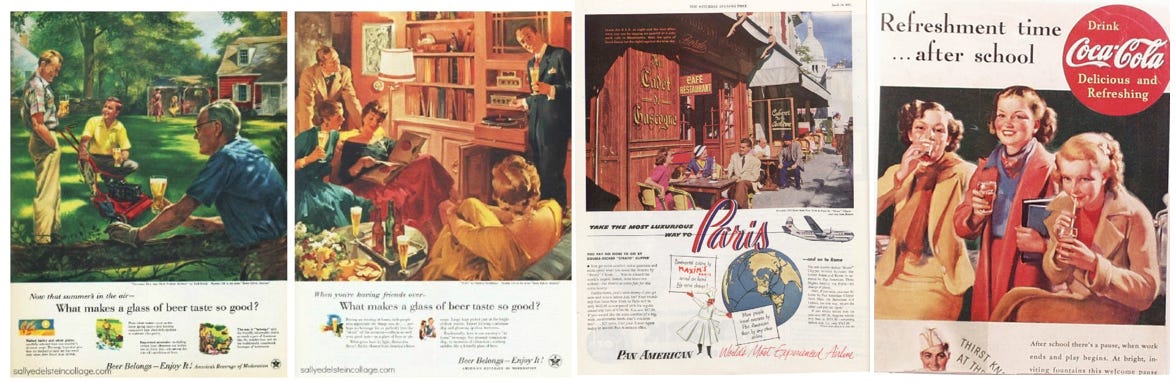
It’s not really about manufacturing. It’s about the life people had when manufacturing dominated our economy. It’s about the sharply dressed All Americans we see above immersed a life of leisure at home and abroad, enjoying each other's company amid the marvels that modern manufacturing has minted. These are the images, and ideas that that are evoked and intended when people invoke the power and promise of American manufacturing. It is this lifestyle of stability, fulfillment, abundance, prosperity, and content that people yearn to reclaim. America was better when we made things. People’s lives were better when we made things.
The implied retrofuturist narrative here is a myth, not necessarily because it is false. It indeed contains certain historical truths. It is a myth because this narrative has, regardless of whether it is true or false, become sacred to so many, shaping what they believe and how they behave, who they vote for and what policies they support. Many, if not most, economists have rejected the notion that this manufacturing-based paradigm is retrievable. Yet, their objections are irrelevant. This narrative has attained the status of the sacred and is, therefore, irrefutable in the minds and hearts of adherents.
It is true that in the Golden Age of 1950s, the post-WWII acceleration of industry, technology, consumerism, and births sent U.S. GDP northward and set the stage for 75 years of American dominance. Yet, in adjusted dollar terms, most Americans are financially better off today and work far less today than back in the 50s.
So why the desire to return to an era where people actually worked more and had less? While there are economic reasons, such as more pronounced wealth and income inequality, that could be fomenting the myth of manufacturing, the level of fervor and devotion to this ideology seems to indicate a deeper psychological and sociological anxiety. The problem, I contend, is more social than it is economic.
Indeed, the social construct of society has changed in slight but impactful ways since the 1950s. For instance, we still have living rooms, but the family dynamic—where there is one—looks a lot different from then to now:
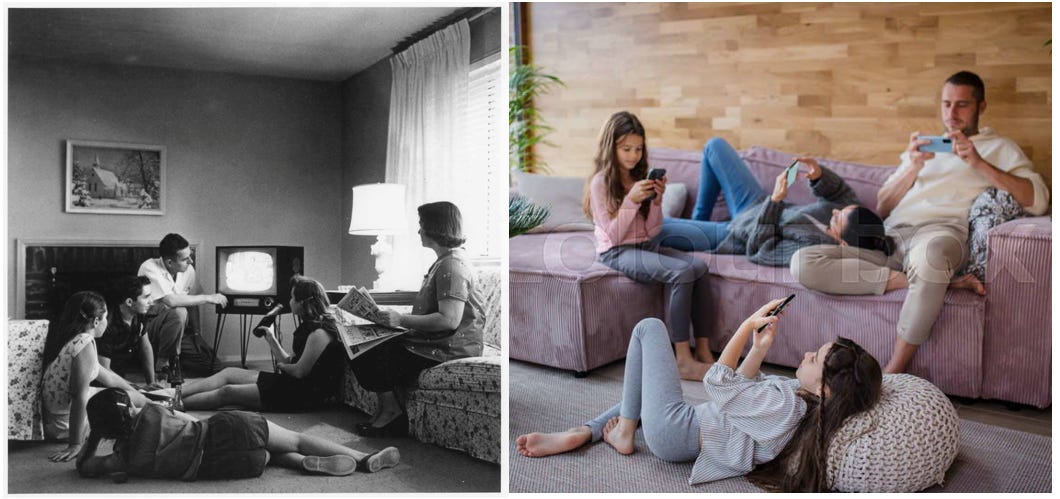
In the 50s, families gathered together to share experiences. Network television enabled a communal experience that was shared by everyone, regardless of your background, location, or income. Today, the proliferation of devices and content has created a household where family members experience different things separately. No longer are we sharing a common encounter, but pursuing our own journeys, which may bring us together or lead us apart, but in either case eroding the sense of community and unity that is so obviously present in many of those vibrantly colored advertisements from the 1950s.
Similarly, people in the 1950s gathered in community to exchange information and conduct commerce. Tupperware Parties, for instance, were an inherently social gathering. In fact, the socialization component was a big part of the draw. Today, conversely, such information is characteristically shared by lone influencers on their phones and received by lone individuals on their phones, not in a social setting but in a solipsistic one.
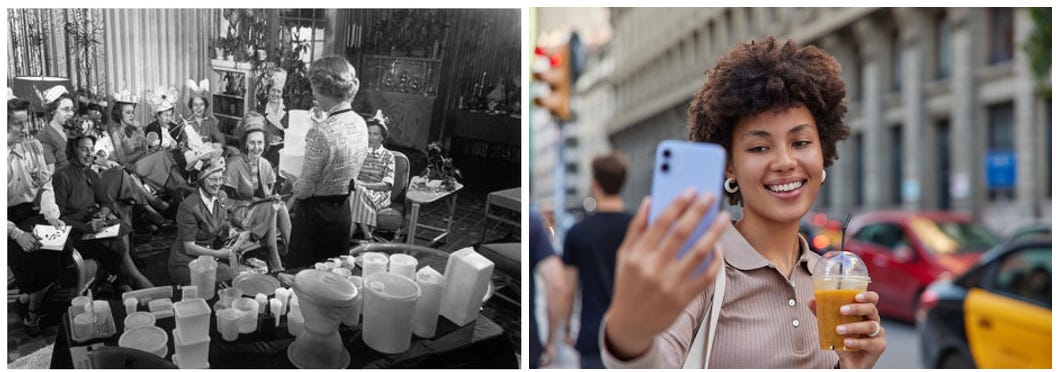
The very act of interacting with thousands or even millions through one’s phone has an opportunity cost. It sacrifices the opportunity to interact with those who are actually present. Even though the internet enables one-to-many communication, the lived reality of how information is shared is most often one-to-one. Gone is the social and communal dimension of information transfer, a shift perhaps exacerbated by the creeping normalization of pandemic era social distancing practices.
Is it possible that the Golden Age of the 1950s seems so retrospectively resplendent because people behaved more like people and less like extensions of their technology? Is it possible that the 50s represented a better balance between technological convenience and social fulfillment? Is it possible that people were more content because they were a part of a more cohesive community? Is it possible that in the decades since our country evolved beyond the manufacturing stage of its economy that people have actually become more manufactured? In the 50s, people’s livelihoods may have been predicated on the manufacture of products, but their lives were predicated on interaction with people.
Is it also possible that, in addition to these types of technology-driven social shifts, the manufacturing paradigm gave people more pride and purpose in their work? After all, the act of creating something is, according to famed 20th century psychotherapist and Holocaust survivor Viktor Frankl, one of the primary ways individuals find meaning. Manufacturing gave people a sense of accomplishment. Through their labor and technique, something tangible, physical, usable, consumable, valuable was produced, something their family and friends, neighbors and colleagues could purchase and enjoy.
Fast forward to today. The value our “tertiary” service-based economy produces value that is often more ephemeral, more transitory, and less concrete than the physical goods produced through manufacturing. For instance, an electrician fixes things but doesn’t produce anything new. Manufacturing in the 50s also required some level of skill. A retail store associate, on the other hand, has very few unique skills. Even though manufacturing was often repetitive, the thing you created was often something you could use or consume. Conversely, a hair dresser can’t really use or consume their work. Is it possible that, today, our non-cognitive routine jobs feel less meaningful because they are, ultimately, less creative?
Even some STEM related careers championed by educators over the last 20 years are becoming less creative and more routine. For instance, Tech executives have warned that AI will start obsoleting some software engineer jobs as no-code development tools continue to improve. Even if these new AI tools don’t eliminate software developer jobs, they may make them more routine, less creative, and ultimately less meaningful. If we aren’t making things, if we aren’t creating things, do we sacrifice, at the altar of convenience and efficiency, a vital part of what it means to be human?
Unfortunately, many of history’s most creative and meaningful pursuits, such as art and philosophy, have been abandoned at the pre-collegiate and even collegiate level over the last 30 years in favor of more professionally oriented courses of study. We have traded the disciplines that deepen and dimensionalize human existence, that allow us to be creators and ideators, for those with more practical application. Ironically, many of the occupations, save perhaps those in the healthcare industry, that people chased out of our educational system over the last few decades are now being disrupted by AI and automation. In fact, some of the most resistant careers are those that intersect creativity, compassion, community, and culture. Given how aggressively we have exorcised the liberal arts from our educational system and our society, is it a surprise that we are so starved for creativity, so starved for community?
Maybe the golden age of the 1950s can indeed be ours again, but more domestic manufacturing is not the solution. It’s a red herring. It’s a solution to the wrong problem. The real problem isn’t that people need more manufacturing jobs (which they don’t want anyway). In fact, the average manufacturing wage is not much more than the national average for all jobs. The real problem is, it seems to me, that people are starved for the sense of purpose, meaning, and belonging that accompanied the manufacturing paradigm of the 1950s. Back then people took pride in their work. They felt a sense of creativity and accomplishment that gave their work meaning. They went home to a tighter knit community with a single, shared collective experience. Out of the ashes of the Second World War came a world that felt orderly, cohesive, and hopeful. Such a world can be ours again, but we need to demythologize and desacralize the myth of manufacturing.
The problem isn’t the lack of manufacturing, it’s the lack of creativity, community, and humanity. These are the things we need to focus on reclaiming, and they can be reclaimed without burning to the ground the world order that prior generations worked so hard to manufacture.