

Immersive experiences are generally demarcated by their ability to make you feel as if you’ve been transported into another reality. They typically involve a combination of visual, programmatic, environmental, and thematic elements that converge to create the perception that you are somewhere else. They are often interactive, multi-sensory, hyper-stimulating, and often leverage the built environment and architectural and artistic design to contain you in some artificial world. There are an increasing number of these experiences popping up in cities around the country, but I have not seen a tremendous amount of comparative analysis of these experiences.
Interestingly, lessons from Religious Studies can help identify and illuminate the characteristics that separate top-performing immersive experiences from more pedestrian ones. Religions, after all, have been creating immersive experiences for millennia.
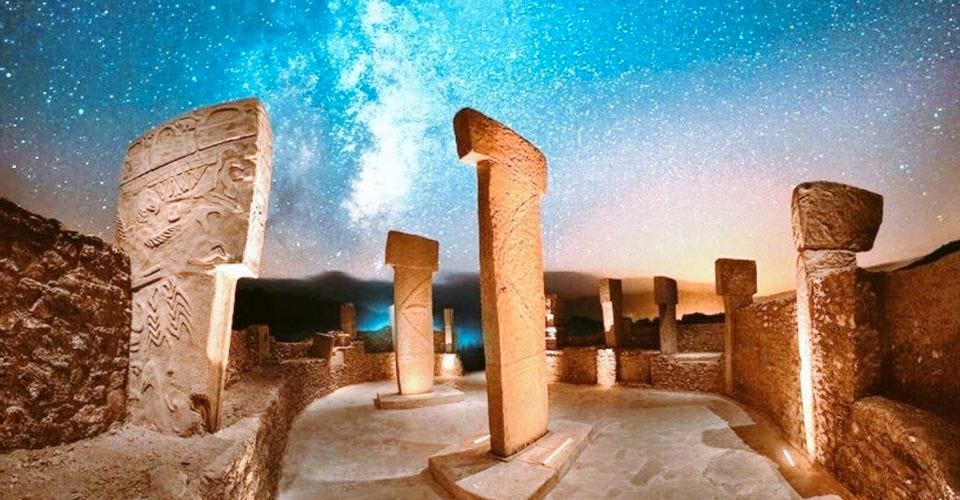
Take Göbekli Tepe in Turkey, for example. At over 10,000 years old, Göbekli Tepe is widely regarded as the oldest existing religious site and likely functioned as the central temple of the village. With giant pillars scraping the sky, Göbekli Tepe would have undoubtedly awed neolithic denizens, teleporting them into the heavens and bringing them closer to their gods. In its day, this structure likely represented an a level of immersion and experience surpassing anything the world had seen.
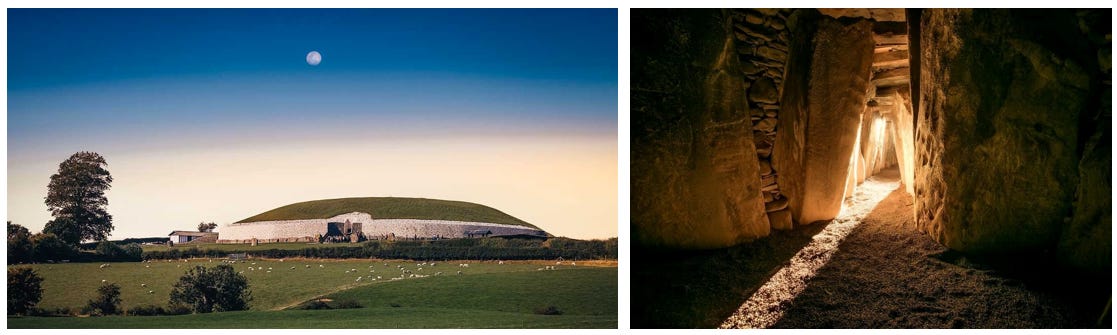
Newgrange in Ireland, an over 5,000 years old monument-tomb, represents an even more sophisticated approach to building immersive religious experiences, using architecture to create time-based light effects. On the Winter Solstice, sunlight enters a small opening on the roof of the Newgrange mound at a precise angle such that the light is guided down the mound’s passageway and into the burial chamber. As the sun continues to rise, the sunbeam expands to illuminate the entire chamber.
Far from being a clever lighting gimmick, the entrance of light into the tomb on the Winter Solstice held spiritual significance for Newgrange’s builders and was intertwined with their religious mythology. In ancient Irish mythology, Newgrange is described as a passage into another world and the tracing of light through the darkness on the Solstice is reminiscent of the myth of the chief god, Dagda, coming into the world and suspending the sun to lengthen the day (in pursuit of a woman, no less). At Newgrange, light, darkness, space, and time all intermix to create a unique immersive experience enhanced by the deeper spiritual meaning imparted through its mythological connections.
Like Göbekli Tepe and Newgrange, many modern immersive experiences rely heavily on the design of the built environment to influence what we see, hear, think, and feel. One common tactic is the use of the “cathedral effect,” in which high ceilings are employed to evoke a sense of awe and wonder. This effect is often accentuated by moving people from a more confined space with lower ceilings into an area with more volume and higher ceilings to create contrast and amplify the effect. Beyond actual cathedrals and places of worship, a lot of structures use this tactic to enhance the experience of their spaces.
But, the emotional impact of the cathedral effect is typically more pronounced in environments that have cultural or mythological significance. Take the examples below. The Burj al Arab hotel lobby (top left) and Singapore’s Changi Airport (top middle) are architecturally striking structures and undoubtedly inspire a moment of awe. Similarly, Meow Wolf in Denver (top right) uses a literal cathedral of color set in a cavernous room as the centerpiece of its immersive experience. Entering the room for the first time, one can not help but pause in surprise, arrested for an instant by the vividness of the cathedral at Convergence Station. Yet, all of these are purely visual delights. They are spectacle for the senses, but do not evoke a strong, enduring emotional or cognitive reaction. As such, none of these experiences is likely to be as memorable or impactful as the bottom three.
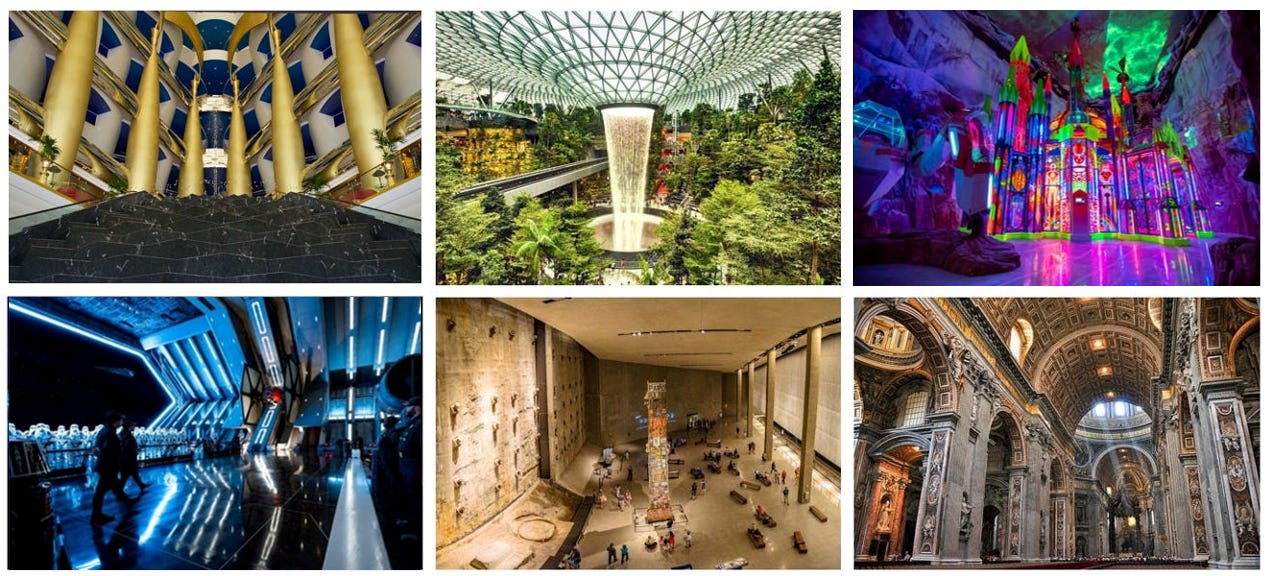
For the Star Wars fan, entering the star destroyer hangar in the Galaxy’s Edge Rise of the Resistance ride (bottom left) pulls fans into a place that they’ve only seen on screen, a reality they’ve dreamt of since they were kids and longed to be a part of. Walking into Foundation Hall in the 9/11 Museum (bottom middle), the din of the other visitors is diminished by the cavernous space, their voices reduced to distant echoes as silent reverence takes hold, the enormous hall reflecting the enormity of the most scarring tragedy in our collective memory. Still globally unmatched is the scale and grandeur of St. Peter’s Basilica (bottom right), which has for centuries made believers and non-believers alike feel both small—as miniscule as we must be in the eyes of God—and in the same instant deeply connected to those around us and the heavens beyond us.
The places on the bottom row have more experiential gravity, more felt power because they draw on familiar narratives to connect us to a bigger mythology, to our beliefs, our memories, ourselves. They are not just sensually striking. They are inherently meaningful. They use immersive techniques to manifest a myth, a story, a past, a future, the here and now, and the hereafter. They are not spectacle for the sake of spectacle. They are spectacle in the service of something deeper, something more profound, something that we and those around us care intensely about.
The lesson here for immersive experiences is to create concepts that go beyond the sensory and incorporate intellectual, emotional, and cultural elements that can tap into accepted myths and narratives to deepen and dimensionalize the experience. Alternatively, if you’re creating a self-contained experience from scratch, creating a companion mythology can help make an experience more dynamic, immersing people not only in a space, but a story.
Myth’s close relative, ritual, is another critical ingredient in the world’s most powerful and memorable experiences that religions have long leveraged. It’s not just about the built environment. Something has to happen in that environment. The architecture of a church can be powerful, but the space is activated through ritual, through the rites and liturgies, the scents and sounds, the motions and movements.
One reason the Roman Catholic Church has been enduringly successful is its employment of ritual, sacraments, and sacramentals as experiential tools. Worshippers dip their fingers into water. They inhale incense. They hold the cup in their hand, the wine on their lips, the bread on their tongue. They sit. They stand. Each action signifying some otherworldly meaning. These types of activations make the experience highly participatory. Worshippers do not simply observe. They partake. They are now part of the experience, part of the story, part of the myth. They are not simply onlookers or bystanders staring at a spectacle, but participants helping to power the spectacular. This type of coherent activation is necessary to create an experience that feels truly immersive. But, it’s not just about activity for the sake of activity. Each action needs to be connected to all the others and all the actions, collectively, need to strengthen the underpinning idea or point of the experience. A unified throughline of actions that tells its own part of the larger story.
For a non-religious example of this we can return to Star Wars: Galaxy’s Edge, an impressively immersive land that includes themed dining, retail, rides, and performances. Disney’s park staff are famously called cast members, a title that is well-deserved at Galaxy’s Edge where the attire of the employees bolsters the experience. Beyond this, however, Galaxy’s Edge includes live performances featuring characters from the Star Wars movies that tie into the storyline of the rides, particularly the land’s marquee ride, Rise of the Resistance. The characters also interact with guests, further deepening the level of activation and participation. You observe the story unfolding in the park, are enrolled into the story through interaction with the characters, and then become a character yourself on the rides.
Other themed experiences, such as ride-based theme parks (as opposed to experience-based parks) and art-driven experiences such as Meow Wolf, lack this level of activation. Participation is limited to interaction with the environment, but there are no interpersonal elements or recurring ritual-like activities. The lack of activation and participation, however, reduces the immersive realism of such “experiences.”
Charting the variety of the experiences mentioned above on a spectrum might yield something approximating the scale below, where experiences often labeled as immersive can range from quasi-immersive to completely immersive and have varying levels of reality distortion, with reality replacing being a complete subversion and substitution of known reality with an alternative one.
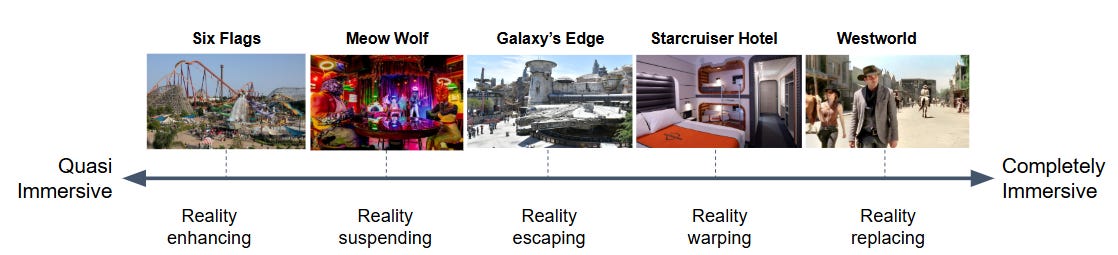
Legacy theme parks such as Six Flags are merely quasi-immersive, only enhancing reality but at no point do guests in these experiences feel as if they have stepped out of their own reality. Such theme parks leverage physical thrills to enhance reality, but are not surrounding guests with a new one. Meow Wolf and similar experiences suspend reality by surrounding guests with a high-spectacle, high-stimulation environment that is largely enclosed (i.e. once you’re in the environment, you can’t detect the external environment). The use of space, light, sound, contrast, and anachronistic detail helps suspend reality while in the environment. However, such experiences lack activation and a strong narrative throughline (although there is typically some basic tangential and unessential storyline). As we’ve seen, Star Wars: Galaxy’s Edge allows you, to some degree, escape reality by making you a participant in a highly activated and interactive largely closed environment. For many, this is the ideal level of immersion. It transports you to another world, one you know and have an affinity for, surrounds you with activity that makes you feel like you are part of that world, but never to a degree that is uncomfortable, threatening, or awkward.
This is perhaps the magic of religious experiences. The best ones surround you, arouse you, engage you, and make you an actor in the drama unfolding. It’s not just about inspiring environments that embody a religion’s myths. It’s also about activation and participation that strengthen that mythology. This is ultimately the entire point of Galaxy’s Edge, to reinforce and deepen the Star Wars mythology, bringing it to life in ways that cannot be achieved on screen.
Disney’s Star Wars: Galactic Starcruiser Hotel, however, was an example of an experience that was perhaps too immersive, warping reality to a degree that made people feel trapped and out of place. The hotel was conceived as an entirely closed, fully immersive, live action role playing experience that asked hotel guests to role play characters within the broader narrative unfolding throughout a spaceship-hotel called the Halcyon. Disney’s intent was to make people feel—and think—like they were actually in the Star Wars universe. Some observes even dubbed it Westworld for Star Wars fans, making Starcruiser arguably the most immersive experience ever devised. While the price point was a huge impediment to the hotel’s success, many reported that the experience was too regimented and too immersive, creating a rigid, participatorily claustrophobic, escape room-like experience—not necessarily how most people want to spend their Disney World vacation. Needless to say, the market for this level of immersion is significantly narrower than that of Galaxy’s Edge. Perhaps predictably, Starcruiser closed after 18 months in operation.
There is perhaps an uncanny valley of immersive experiences, where the commercially ideal level of immersion is accomplished at a reality escaping level, a level where people can participate when they want and disengage when they want. If one is using immersive experiences as a form of entertainment, an overly immersive experience such as Starcruiser might make participants feel trapped, stuck in a world not their own. No longer are they tourists in a novel universe, but permanent residents. No longer are they teleported into a spectacular environment, but held against their will. At some point, people remember that they’re still an accountant from Iowa on vacation with their family. They are not a member of the rebel resistance, as much as Disney may try to convince them they are. They still have to worry about the cost of the trip, the emails backing up, the sick family member at home, whether the neighbor remembered to walk the dog. Whereas Galaxy’s Edge captures a religion-esque level of participatory reality distortion, Starcruiser borders on a cult that you can’t escape. Immersive experiences are meant to be an escape, but they implode if they start to feel like something you need to escape from.
At the extreme of our spectrum is Westworld, a fictitious experience depicted in HBO’s television series of the same name. A Westworld-depth experience may pull participants out of the uncanny valley by achieving a level of immersion that is entirely reality replacing, where there is no awkward role playing required because the experience is so real, so complete, so perfect, so participatory that it becomes your new reality. Not even religion accomplishes this level of reality replacement. Despite its efforts, religion is not actually able to transport people out of this plane of existence and into a higher one. The sense of otherworldliness created by religion is still manifest in the world we know. Given the advance of AI and robotics, a Westworld-like experience that serves as a near-total replacement of the reality could one day exist. What impact such experiences will have on humanity’s sense of reality and sense of self is yet to be seen.
The one advantage that religion has, and may always have, over secular immersive experiences is that people believe the underlying myth to be true. Regardless of how immersive Disney makes Galaxy’s Edge, nobody believes that a long time ago in a galaxy far far away the Star Wars saga actually occurred. It is known to be fiction and, as such, its derivative experiences offer merely entertainment value. Conversely, religious experiences create profound existential value, forming the basis of people’s sense of self, meaning, and belonging. While Star Wars has a devoted community of fans, few if any would be willing to die in the name of the rebellion. Nonetheless, a Star Wars themed experience is likely to be more meaningful to people than a more recently constructed and mythologically thin experience such as Meow Wolf, underscoring the importance of having a larger, more expansive mythology to undergird and power the experience.